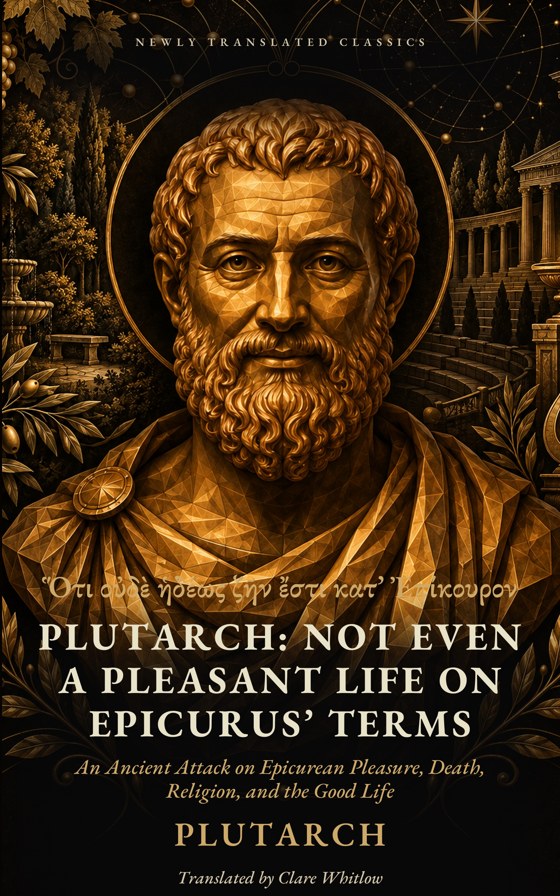
Plutarch: Not Even a Pleasant Life on Epicurus’ Terms
An Ancient Attack on Epicurean Pleasure, Death, Religion, and the Good Life
by Plutarch · Translated by Clare Whitlow
A new English translation, made directly from the original language.
Can a philosophy devoted to pleasure actually make a pleasant life impossible? In this sharp and wide-ranging attack on Epicureanism, Plutarch takes the charge that Epicurus’ follower Colotes had leveled at other philosophers and turns it back on the Epicureans themselves. If pleasure is the highest good, he asks, can bodily comfort ever provide lasting happiness? And what happens when a philosophy dismisses many of the experiences that give human life its depth: learning, public service, religious hope, honorable action, and the expectation that the soul may survive death? The discussion unfolds as a lively conversation between Plutarch and his companions after a lecture. Their argument moves from physical pleasure and pain to memory, friendship, music, poetry, science, politics, worship, and mortality. Along the way, Plutarch quotes and paraphrases writings by Epicurus and Metrodorus that are now partly or entirely lost. The result is both a forceful philosophical prosecution and an accidental archive of the school it seeks to defeat. Plutarch, born around AD 46, was a Greek philosopher, priest, biographer, and essayist under the Roman Empire. Best known for the Parallel Lives , he also wrote extensively on ethics, religion, politics, and rival philosophical traditions. Although openly hostile to Epicureanism, he preserves its arguments with unusual detail, making this essay valuable to readers on both sides of the dispute. What makes this edition different: Complete and unsoftened. The ancient work is presented without abridgment or alteration to suit modern sensibilities. The few gaps marked in the Greek edition are shown as gaps, not filled in. A close new English translation. The argument, quotations, repetitions, and polemical force of the Greek are preserved rather than freely rewritten. Clear contemporary language. The prose remains readable while staying close to Plutarch’s reasoning and conversational structure. Helpful historical framing. The introduction explains the dispute with Colotes, the dialogue setting, and the importance of Plutarch’s surviving quotations from lost Epicurean works. A focused reader’s edition. The text carries the traditional section numbers and no heavy academic apparatus interrupting the debate.
This English translation is an original work, © 2026 Clare Whitlow / Lucilius Press · all rights reserved. The underlying ancient text is in the public domain.