Lucilius Press › Reading guides
Epicurus' complete works in modern English: what actually survives
There is no complete works of Epicurus, because almost everything he wrote is lost. Ancient sources say he filled about three hundred rolls. What survives is three letters, the forty Principal Doctrines, the eighty-one Vatican Sayings, scattered fragments quoted by later writers, and damaged papyrus pieces of his long work On Nature.
What a "complete" Epicurus can honestly contain
The three letters come down to us because Diogenes Laertius copied them into his life of Epicurus, written centuries later. The Letter to Menoeceus is about how to live. The Letter to Herodotus summarizes his physics. The Letter to Pythocles covers the heavens and the weather. The Principal Doctrines are forty short maxims his students learned by heart. The Vatican Sayings are a further set of maxims found in a manuscript in the Vatican Library in 1888.
On top of that, later writers like Seneca, Plutarch and Cicero quoted lines and reported his views. And burned papyrus rolls from Herculaneum hold pieces of On Nature, which scholars are still reading.
Where the standard English versions stand
Two long-standing scholarly collections are Cyril Bailey's Epicurus: The Extant Remains (Oxford, 1926), with Greek and English, and The Epicurus Reader edited by Brad Inwood and L. P. Gerson (Hackett, 1994), a teaching collection of texts and testimonia. The letters also appear in R. D. Hicks's Loeb translation of Diogenes Laertius (1925).
What the Lucilius Press edition contains
Epicurus: The Philosopher of the Garden is a modern plain-English translation. It gathers the three letters, the forty Principal Doctrines, the eighty-one Vatican Sayings and a selection of fragments and testimonia, with an introduction and a glossary. It leaves out the papyrus pieces of On Nature, and the book says so in its preface. It is a selection, not a complete Epicurus: it does not include the papyrus pieces of On Nature or every quoted fragment, and its fragments section says so.
2. Death is nothing to us. What has been broken down into its parts has no sensation, and what has no sensation is nothing to us.
3. The limit of the size of pleasures is the removal of everything that gives pain. Wherever pleasure is present, throughout the whole time it lasts, no pain of body or of mind is there, nor both at once.
4. Suffering in the flesh does not run on unbroken. Pain at its most acute is there for the briefest while; the kind that merely tips the balance past bodily pleasure does not persist for many days; and drawn-out illnesses hold even more of what is pleasant in the flesh than of what hurts.
5. It is not possible to live pleasantly without living prudently and finely and justly, nor to live prudently and finely and justly without living pleasantly.
From Epicurus: The Philosopher of the Garden, translated by Owen Halloway, Lucilius Press. Principal Doctrines 2 to 5. Free sample, reproduced from the book.
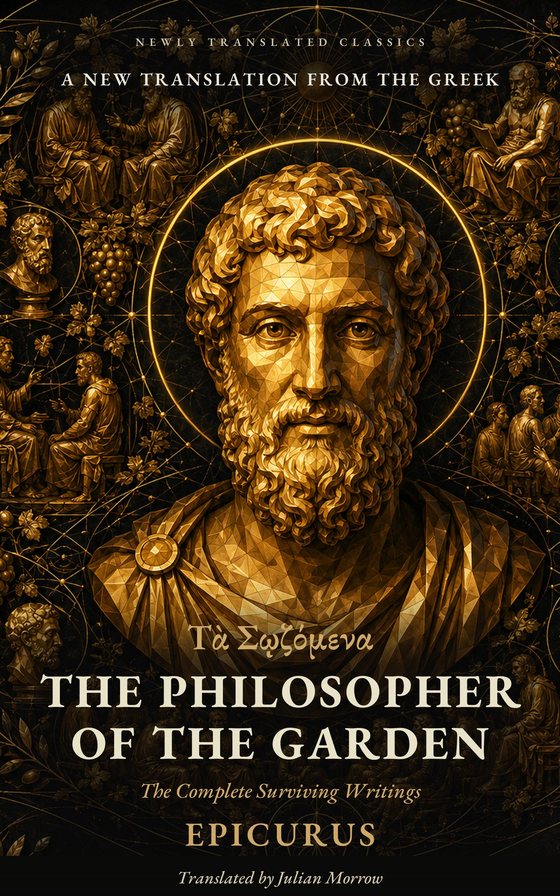
Epicurus: The Philosopher of the Garden
Translated by Owen Halloway